LinkedIn
 Facebook
 X.com
X.com
 WeChat
 Email
Email

If you ask a commercial director of an e-commerce supply chain how to reduce parcel delivery spends, they will almost always give you the same answer: “Get a bigger base-rate discount.”—
For years, this was the accepted math. You aggregated volume. You went to the ‘Big Two’ with your requirements. You pressured to shave 2% off the top. They did. You declared victory.
But it’s 2026. And that equation is broken.
While you were negotiating the base rate, the total cost to serve exploded. And the “cheapest” rate for your parcel delivery service became the most expensive (unmodeled) line item on your P&L. Let’s understand the math.
The hidden elephant in your e-commerce ops P&L
Traditionally, the e-commerce parcel strategy was always governed by a single, linear equation.
The old math of parcel: Volume x (Rate – Discount)
It’s clean. It’s measurable. And for a long time, it worked.
The equation was built on volume consolidation. You aggregated as much volume as possible and negotiated a deep discount based on sheer scale to optimize your parcel performance. The assumption was simple: more volume gave more leverage and lower prices. Speed and cost of delivery were the primary levers and they delivered acceptable results. This was the world of centralized inventory, predictable demand, and relatively stable carrier networks.
Rates were visible. Discounts were contractual. Volumes were forecastable—at least in theory.
But here’s where it failed.
The need for new math in parcel delivery
The e-commerce supply chain changed the conditions under which that equation operated.
The old equation assumed the ‘final rate’ was the final cost while ignoring the variables of an ever-changing market. With distributed fulfillment, volatile demand patterns, regional carrier fragmentation, and customer expectations that tolerate little silence or uncertainty, the old math looked tidy on paper—but it failed to reflect what parcel delivery actually cost the business. The old math was now producing a deficit in brand equity and operational stability. Now, it carries a growing set of system-level costs that don’t disappear when ignored. They simply surface elsewhere—in operations, finance, customer experience, and brand risk. According to McKinsey, fulfillment costs account for 12–20% of e-commerce revenues.
So, what changed was not the rate. But everything around it.
To understand the real economics of parcel delivery today, the equation needs to expand.
The hidden taxes in modern parcel delivery economics
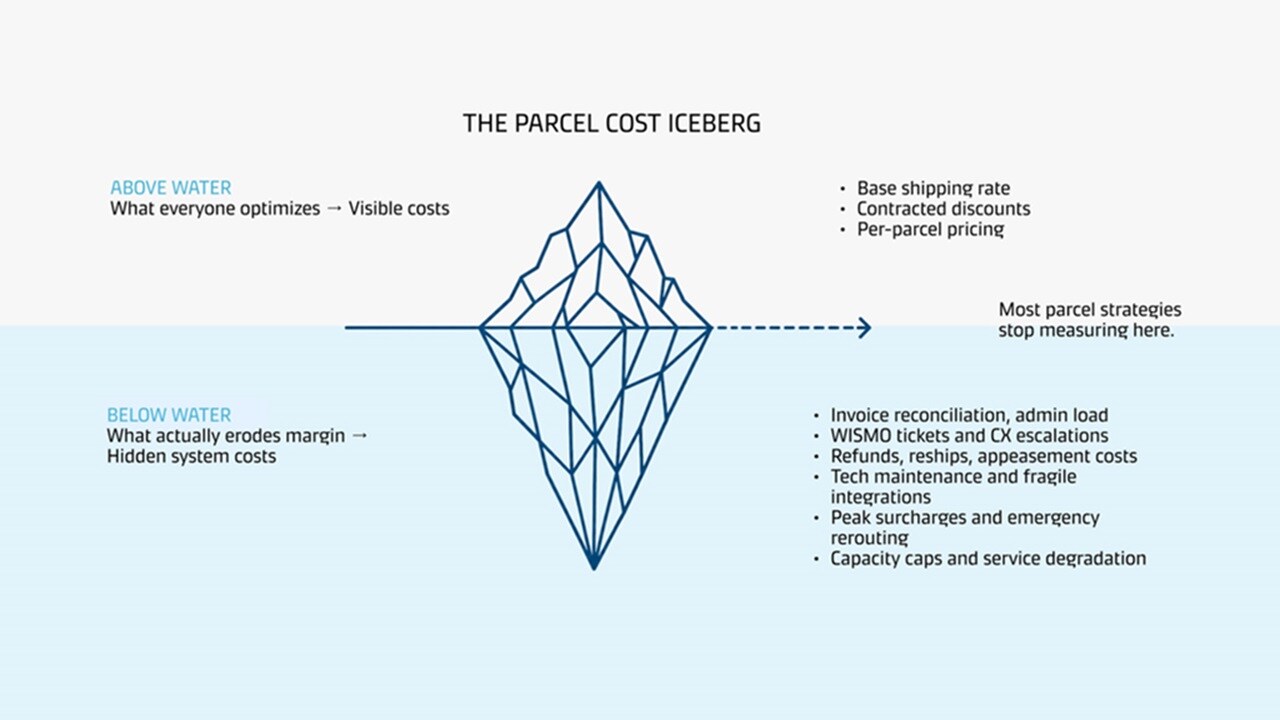
Variable A: The administrative tax
This is the cost of complexity.
It is the ongoing operational overhead required to manage fragmented parcel execution.
- As shippers add carriers, regions, and delivery partners to improve coverage or reduce per-shipment rates, coordination increases. Each additional provider introduces its own contracts, invoices, system integrations, service levels, and escalation paths.
- Diversification often begins as a tactical cost-saving effort, but creates a parallel cost structure and fragmented system—that sits outside the initial base rate offered.
Why it’s usually excluded: Because administrative load doesn’t appear on a rate sheet. It accumulates across teams, workflows, and internal complexity— treated as the ‘cost of doing business’, rather than part of parcel economics itself.
How it shows up financially:
- Permanent operational headcount dedicated to vendor coordination
- Ongoing reconciliation efforts across multiple billing structures
- Slower decision-making as changes required cross-team realignment
Over time, this distinction becomes clear: either complexity is absorbed by the system—or it is absorbed by people.
Imagine a scenario where you’re a medium-sized shipper... and you have an issue in your supply chain. And if there is a disruption with Carrier A—instead of your team scrambling to fix the problem—our system can automatically move volumes to Carrier B or C. That happens under the hood, keeping everything flowing smoothly downstream.
Variable B: The network tax
This is the cost of fragmentation.
It is the price for operating on a parcel delivery network that was never designed to function as a single system.
- Parcel networks evolve incrementally (lane by lane, provider by provider) rather than through deliberate system planning. Over time, the network grows wider but weaker—introducing handoffs, redundancies, and service variability.
- What results is a collection of capable service providers. But they operate without a unified logic for routing, prioritization, or accountability. 13–19% of logistics costs stem from inefficient handoffs—between shippers, dispatchers, 3PLs, and carriers at the time of delivery—resulting in $65–$95 billion dollars in losses in the United States alone.
Why it’s usually excluded: Because network design decisions are often historical, inherited, or decentralized—not revisited or revised. The costs are distributed across operations rather than attributed as discrete line items in parcel economics directly.
How it shows up financially:
- Inconsistent service levels or sub-optimal routing decisions
- Increased blended costs per shipment, even when single-lane rates are less
- Higher failure rates due to fragile handoff points between nodes
Operationally, this is how that dynamic plays out when it’s not fragmented:
We don’t force a rigid network on a business. We ask: ‘If you have cost on one side and performance on the other, where do you want to play?’… Then we design the carrier mix, whether it’s 10 different carriers or just 5 premium ones to fit that specific supply chain architecture.
Variable C: The visibility tax
This is the cost of late awareness.
It is the economic impact of identifying parcel delivery issues too late, after they are no longer preventable.
- Many visibility systems prioritize event tracking over deviation detection. Knowing where a parcel is does not necessarily indicate whether it is at risk. But financial value is created only when visibility enables early intervention.
- Fragmented networks produce fragmented signals. As a result, delays, missed handoffs, or capacity constraints are often detected downstream—after delivery windows are missed or customers begin to ask questions.
Why it’s usually excluded: Because tracking is often mistaken for having visibility and control. The timing of awareness and its financial consequences is rarely accounted for explicitly. On the other hand, true visibility answers if intervention is still possible before cost and trust are lost.
How it shows up financially:
- Increased customer service escalation volumes
- Refunds, reships, and appeasement requests
- Loss of customer trust long before a delivery officially fails
But when visibility is working in your system and supply chain, it can look like this:
Visibility isn’t just tracking a package or watching the dot move. It is identifying when a package stops moving. Our system flags exceptions—like a label that hasn’t been scanned in 24 hours—so our teams can intervene before it becomes a disruption or a delay.
Variable D: The escalation tax
This is the cost of customer-facing failure.
It is incurred when parcel issues move out of the system into customer experience (CX) teams.
- When issues (such as delays or disruptions) are not identified early or resolved late, they surface through customers rather than systems. CX teams become the first responders to operational failures in e-commerce supply chains.
- 0.1% of B2B shipments are lost/stolen in middle and last-mile deliveries. At scale, these escalations compound, drawing in support teams and operations leads during peak or high-volume periods—resulting in significant loss of resources and brand equity.
Why it’s usually excluded: Because escalation costs are distributed across customer experience (CX), operations, and revenue functions. They rarely appear in parcel cost models, even though they materially affect profitability and brand equity.
How it shows up financially:
- Higher customer support and escalation volume
- Refunds, credits, and service recovery costs
- Long-term erosion of customer trust and lifetime value
When parcel issues do surface, this is what operational ownership looks like.
We can pretty much explain what has happened with any package, even when shipping thousands of parcels a day. That isn’t an accident, it’s because we closely manage every parcel and can explain almost any exception. Our goal is to identify potential losses or delays proactively before they impact the customer’s parcel delivery.
Variable E: The volatility tax
This is the cost of instability.
It is the premium paid by parcel delivery systems that are not designed to absorb disruption or change without manual intervention.
- E-commerce delivery demands are no longer linear. Promotions, weather events, labor disruptions, and regional capacity constraints are structural realities, not edge cases.
- Systems built on old models for stability struggle under these conditions, relying on manual rerouting, temporary workarounds, or emergency capacity adjustments.
Why it’s usually excluded: Because volatility is often treated as temporary, even though it has become a permanent operational reality. And it doesn’t increase costs directly. It exposes systems that weren’t designed to work around it.
How it shows up financially:
- Peak season surcharges and emergency rerouting measures
- Increased operational strain during promotions or disruptions
- Greater exposure to service failure and reduced supply chain resilience
At scale, volatility doesn’t create isolated failures—it amplifies them across the network.
One single delayed line haul or a missed handover can actually impact hundreds or thousands of the parcel downstream very quickly… So, it’s not just about moving the boxes faster, but it’s about meeting the right expectations of the customer—whether it’s the right visibility or the right handling of the situation.
The final equation: Cost of e-commerce parcel delivery
The mistake most e-commerce supply chains make isn’t choosing the wrong last-mile provider. It’s running parcel delivery with an incomplete equation—optimizing what’s visible while absorbing everything else elsewhere in the system. What used to look like savings now shows up as administrative drag. What looked like flexibility becomes network fragility. What felt like acceptable risk surfaces as customer-facing failures.
None of these taxes are dramatic in isolation. Together, they redefine what parcel delivery actually costs. And when you run the full numbers, the difference becomes clear.
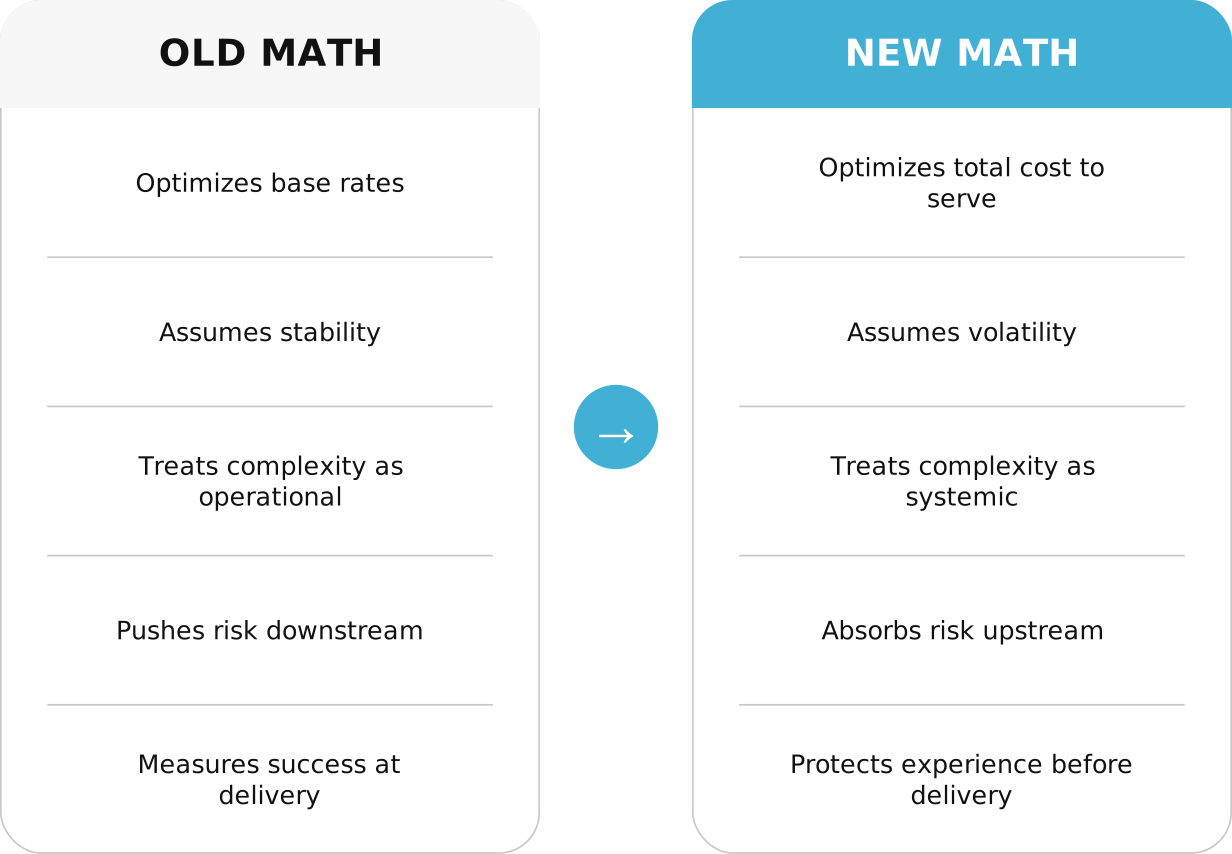
Understanding this doesn’t mean paying more for parcel delivery services. It simply means acknowledging costs that already exist—whether they appear on your P&L or not.
Price is what you pay, value is what you get. I can give you a lower cost, but what are you going to get with that? Is it going to sacrifice service or consumer experience? I think that’d be a bad trade-off.
At Maersk, our e-commerce parcel delivery services are designed around this expanded equation. By orchestrating a multi-carrier network under a single accountable framework, we reduce the hidden costs that most parcel strategies leave unmanaged or unaddressed. The result is not faster delivery or cheaper rates. It is a parcel delivery system built to protect customer experience, operational stability, and long-term economics—at the same time.
If you want to understand what parcel delivery truly costs your business, we can help you run the new equation. Contact our e-commerce commercial team today.