
 LinkedIn
 Facebook
 X.com
X.com
 WeChat
 Email
Email


As 2026 begins, Asia-Pacific supply chains continue to adapt to a complex global environment shaped by shifting trade flows, evolving regulatory landscapes, and the push for greater resilience. While regional demand remains steady in key corridors, ongoing uncertainty across geopolitics and policy is prompting businesses to prioritise flexibility, visibility, and speed. In this quarterly update, we provide the latest insights across ocean, air, inland, and contract logistics — and highlight how Maersk supports customers with integrated, tech-enabled solutions tailored to a changing market.
Market Trend
China Export Recovery Reinforces Market Resilience
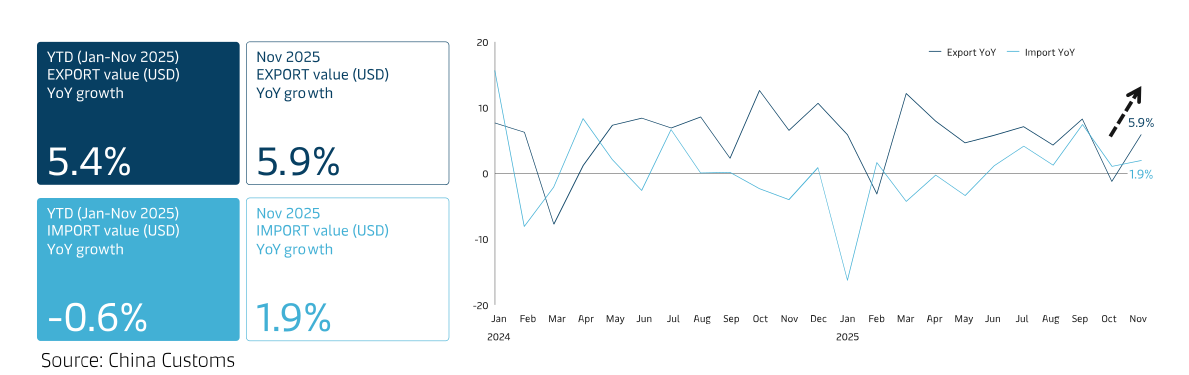
China’s exports rose 5.9% year-on-year in November 2025, bringing year-to-date growth to 5.4%, according to China Customs data. Imports also edged up 1.9% in November but remained down 0.6% over the first eleven months. The data reflects China’s sustained trade resilience amid global volatility.
Export Demand Shifts Toward Emerging Markets
While exports to the US declined sharply, falling 29% year-on-year, demand from other regions showed strong momentum. Exports to the EU and emerging markets — particularly Latin America, Africa, and Australia — posted significant gains, reflecting shifting trade flows and growing engagement beyond traditional corridors.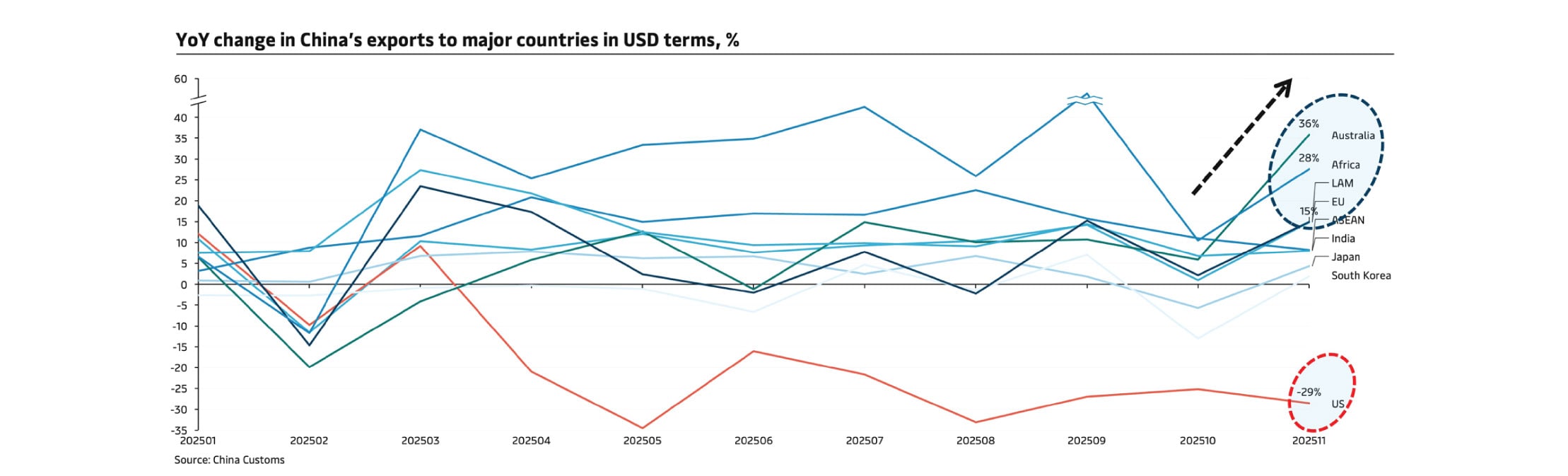
High-Tech Goods Lead China’s Export Mix
China’s export mix is shifting toward high-tech and mechanical-electrical goods. In November, electric passenger vehicles surged over 140% year-on-year, with strong contributions from integrated circuits, data processing equipment, and motor vehicles. This reflects China’s pivot to higher-value exports amid global supply chain shifts.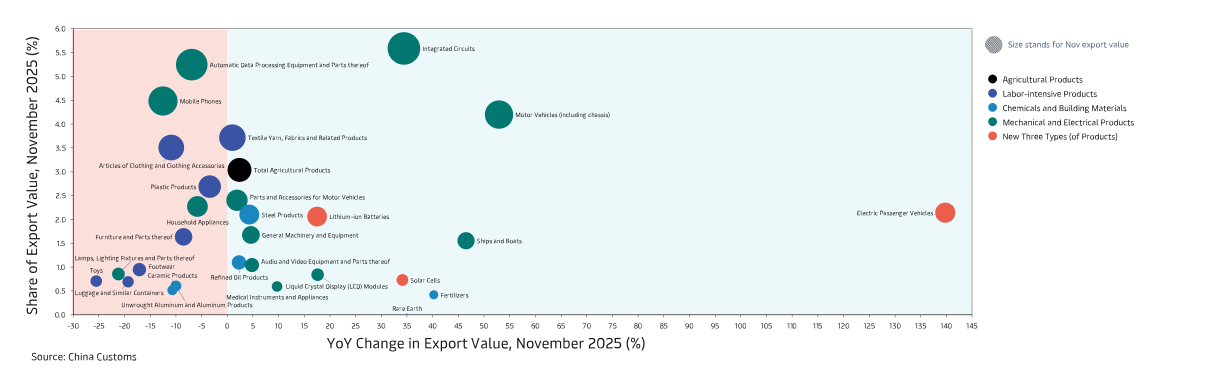
Ocean Market Update
Asia-Pacific ocean freight markets enter 2026 with cautious optimism. While geopolitical uncertainty and capacity volatility continue to shape long-haul trade routes, intra-Asia volumes are gaining momentum, and supply chain planning is increasingly focused on agility, regional connectivity, and early Chinese New Year preparations. Maersk remains committed to supporting customer flows with schedule visibility and reliable service delivery as market conditions evolve.
Red Sea Routing Reassessment Continues
We are closely monitoring developments in the Red Sea area and exploring opportunities for a safe and sustainable return to East-West Suez transit. We can now share that an initial transit has successfully been completed.
On 18-19 December 2025, the Singapore-flagged vessel Maersk Sebarok currently operating on Maersk’s MECL service transited the Bab el-Mandeb Strait and Red Sea. The safety of our crew, vessels and cargo remains of utmost importance to us, and the highest possible safety measures were applied during transit. Customers with cargo on this vessel have been informed directly.
Whilst this is a significant step forward, it does not mean that we are at a point where we are considering a wider East-West network change back to the trans-Suez corridor. Assuming that security thresholds continue to be met, we are considering continuing our stepwise approach towards gradually resuming navigation along the East-West corridor via the Suez Canal and the Red Sea. The first step is this initial sailing, followed by a limited number of additional trans-Suez sailings. However, there are no planned sailings currently.
We will continue to keep you updated on the situation, as well as continue to update our Red Sea webpage. Should you have further questions please do not hesitate to reach out to your local Maersk representative. Our teams are on hand to support with your planning, should you need any assistance.
Evolving Trade Corridors: Growth Beyond East-West
Trade between Asia, Africa, and the Middle East is outpacing traditional East–West routes, driven by manufacturing shifts and growing regional integration. According to Sea-Intelligence, container demand in the Asia/Africa megaregion surged by 22.6% between 2019 and 2025 – nearly triple the growth seen in the rest of the world. Maersk is also scaling its Intra-Asia services and inland capabilities across Asian countries to support evolving flows with speed and reliability.
Operations in Venezuela
We continue to operate where it is safe and compliant with international sanctions and regulations. We are actively monitoring port operations, security conditions, and regulatory updates. Our priorities are safety, service continuity, and full compliance. If conditions change in ways that impact your cargo, we will notify you immediately through official Maersk channels. For questions about specific shipments or routing alternatives, contact your Maersk representative.
Air Freight Market Update
Air cargo flows across Asia-Pacific have entered the new year on a stable footing, following a strong finish to 2025 driven by e-commerce, electronics, and time-sensitive shipments. While market conditions remain dynamic, recent trends point to continued demand resilience across core verticals and trade corridors, with a growth expectation of 2.4%. Maersk continues to support customers with agile air logistics solutions, offering flexibility and end-to-end visibility in a multimodal environment.
Asia-Pacific Demand Shows Strong Year-End Momentum
According to the International Air Transport Association (IATA), Asia-Pacific airlines recorded a 4.1% year-on-year increase in air cargo demand in October 2025, reflecting the region’s strong contribution to global air freight recovery. Capacity also rose by 5.1% over the same period, supported by rising belly-hold availability as international passenger travel resumed. This performance underscores Asia-Pacific’s central role in global supply chains and highlights the ongoing resilience of demand for high-value, time-sensitive shipments originating from the region.
Performance Varies by Corridor and Vertical
Trade lane performance remains mixed. Europe–Asia led growth in October, driven by strong demand for technology and healthcare goods. Middle East–Asia and Africa–Asia also saw solid increases, while intra-Asia flows held steady. Demand on North America–Asia routes remained soft due to cautious inventory strategies and weaker consumer sentiment. Other corridors were broadly stable.
Capacity Recovery Continues, but Gaps Remain
Air cargo capacity continued to improve in October, with global availability up 5.1% and international capacity rising 6.4%, according to IATA. Growth remains uneven across regions, with structural gaps persisting. Maersk is investing in flexible air solutions to ensure space, visibility, and routing agility in complex supply chains.
Inland Market Update
The inland logistics landscape across Asia-Pacific remains shaped by a combination of structural pressures and evolving trade flows. While demand has stabilised in key markets, broader cost, climate, and infrastructure challenges continue to influence inland performance and planning.
Preparing for Chinese New Year
With Lunar New Year, particularly Chinese New Year arriving in mid-February, Chinese and Asian exporters are front-loading shipments to avoid production and transport slowdowns:
- Inventory Planning: Manufacturers are accelerating output to meet pre-holiday demand, particularly in coastal provinces like Guangdong, Zhejiang, and Jiangsu.
- Capacity Considerations: Inland transport networks — especially trucking from central China to port cities — are experiencing early congestion, making proactive planning essential.
- Maersk Response: We are supporting customers with advanced booking options, flexible multimodal services, and enhanced visibility tools to ensure stable supply chain execution during this critical peak.
Spotlight on the Mekong Area
Inland logistics in the Mekong Area – spanning Thailand, Vietnam, Cambodia, and Myanmar – continues to experience structural shifts amid manufacturing diversification and persistent cross-border challenges. Key developments include:
- Increased congestion at Thai ports, driving tighter vendor capacity and potential rate volatility.
- Rising demand for container yard (CY) hubs in North Vietnam, supporting manufacturers and logistics providers managing high-volume movements.
- Strategic warehousing demand is accelerating in Northern Vietnam, driven by a shift of manufacturing and increased demand for Bonded Zone storage.
As intra-Asia trade gains momentum, demand is increasing for seamless cross-border transport options connecting key markets such as China, Vietnam, Thailand, and Malaysia. Regional manufacturing diversification is driving more origin-destination pairings across land corridors, supported by evolving trade agreements and government infrastructure investments.
Customers are increasingly seeking multimodal inland logistics solutions that offer greater visibility, speed, and coordination. To meet these needs, Maersk is enhancing its inland offering through improved digital tools, consolidated documentation processes, and closer integration between ocean and land-side services. These efforts aim to reduce complexity and improve predictability, particularly for time-sensitive or high-volume supply chains spanning multiple countries in Asia-Pacific.
Tariff & Trade Update
Shifts in global and regional trade policy continue to influence sourcing strategies and compliance requirements for Asia-Pacific businesses. Recent tariff developments and trade agreement updates are prompting exporters to reassess market access, landed costs, and routing decisions.
Newly approved tariffs of up to 50% on imports into Mexico from countries without preferential trade agreements may affect selected Asia-Pacific exporters. In response, several industries, particularly in India, are calling for accelerated FTA negotiations to preserve competitiveness. At the same time, stronger China–ASEAN trade integration, formalised through an upgraded free trade agreement signed in late 2025, is expected to reduce friction and improve access across regional markets. Meanwhile, Chinese exports to Southeast Asia rose sharply in 2025, driven in part by efforts to navigate tariff exposure in Western markets.
For Maersk customers, these shifts highlight the growing importance of supply chain flexibility, proactive compliance management, and regional diversification. We continue to support your business with integrated logistics solutions that adapt to evolving tariff landscapes, including multimodal options, trade compliance support, and agile routing strategies tailored to shifting trade corridors.
Maersk Contract Logistics
Digitalisation and automation are transforming logistics across Asia-Pacific, as supply chains demand greater speed, visibility, and control. Maersk continues to evolve its contract logistics offering through investments in smart infrastructure and simplified, end-to-end service models.
At the centre is our flagship fulfilment facility in Lin-gang, Shanghai — a fully integrated site combining warehousing, sorting, customs, and distribution, supported by real-time inventory systems. This digital foundation enables agile fulfilment across regional and cross-border flows.
Beyond infrastructure, Maersk is streamlining operations through bundled logistics solutions that connect ocean, inland, and warehousing — reducing complexity and improving reliability.
Major Ports Update
Waiting time indicator:
| Trade | Less than 1 day | 1-3 days | More than 3 days |
|---|---|---|---|
|
Trade
Asia Ports
|
Less than 1 day
Busan, Dalian, Xingang, Xiamen, Shekou, Yantian, Nansha, Hong Kong, Tanjung Pelepas, Jakarta, Brisbane, Auckland, Melbourne, Tauranga, Sydney |
1-3 days
Qingdao, Shanghai, Ningbo, Ho Chi Minh, Port Klang
|
More than 3 days
|
|
Trade
Rest of World
|
Less than 1 day
Bremerhaven, Rotterdam, Valencia, Koper, Rijeka, Jebel Ali, Colombo, Onne, Tema, Lome, Zanzibar, Pointe Noire, Cape Town, Maputo, Oakland, Los Angeles, Prince Rupert, Vancouver, Tacoma, Houston, Norfolk, Baltimore, Charleston, Miami, Newark, Savannah, Balboa, Lazaro Cardenas
|
1-3 days
Durban, Apapa, Reunion, Port Louis, Abidjan, Djibouti, Cape Town
|
More than 3 days
Beira, Conakry, Dar es Salaam
|
Remark: Above information is correct to the best of our information at the date of publication, remains dynamic and subject to change.
Resources and tools to support you
Visit our “Insights” pages where we explore the latest trends in supply chain digitization, sustainability, growth, resilience, and integrated logistics.
Learn what’s happening in our regions by reading our, Global, Europe, North America, and Latin America updates.
Do you find this market update useful? If you haven’t subscribed to Maersk Asia Pacific Monthly Update yet, click the link below and stay posted!
Subscribe to Asia Pacific Monthly Updates
We value your business and welcome your feedback. Should you have any questions on optimizing your cargo flows, please contact your local Maersk professional.


